

Judgment Under Uncertainty: How Decisions Are Made When Analysis Is No Longer Enough
This is our fourth article in a six-part series looking at the state of Critical Thinking and Decision-Making.


Introduction
The expectation that decisions should follow from sufficient analysis remains one of the most deeply embedded assumptions in modern organizations. It is rarely articulated directly, yet it governs how performance is evaluated, how leaders are trained, and how accountability is assigned. Better decisions are believed to come from better information, more complete models, and more rigorous evaluation. Where outcomes fall short, the diagnosis is typically framed in terms of gaps in data, failures in analysis, or breakdowns in logic. The implicit belief is that, given enough information and time, uncertainty can be reduced to the point where the correct decision becomes apparent.
This belief persists because it is partially true. In stable environments, where variables are known, relationships are consistent, and outcomes can be predicted with reasonable confidence, analysis performs as expected. It reduces ambiguity, narrows options, and supports convergence toward a solution that can be justified and repeated. Much of operational decision-making still occurs within this domain, reinforcing the idea that the same approach should apply more broadly. The difficulty is not that this model is wrong. It is that it is being extended into conditions where its underlying assumptions no longer hold.
“Uncertainty is not a temporary gap in knowledge. It is a condition in which clarity cannot be fully achieved before action is required.”
This distinction is often acknowledged conceptually and ignored operationally. When uncertainty is treated as something to be resolved before acting, analysis is extended beyond its useful range. Additional data is gathered, more variables are introduced, and scenarios are expanded in an effort to reduce ambiguity. What begins as a rational attempt to improve the decision frequently produces the opposite effect. The system becomes saturated with information that cannot be fully integrated. Relationships between variables remain unclear. The number of plausible interpretations expands. Rather than converging toward clarity, the process expands into complexity.
At this point, analysis does not fail in a visible way. It continues to operate, producing outputs that appear rigorous, structured, and defensible. What changes is not the presence of analysis, but its ability to resolve the decision. Leaders are left with more information and less certainty about what that information means in aggregate. The appearance of rigor remains intact, even as the capacity to decide deteriorates.
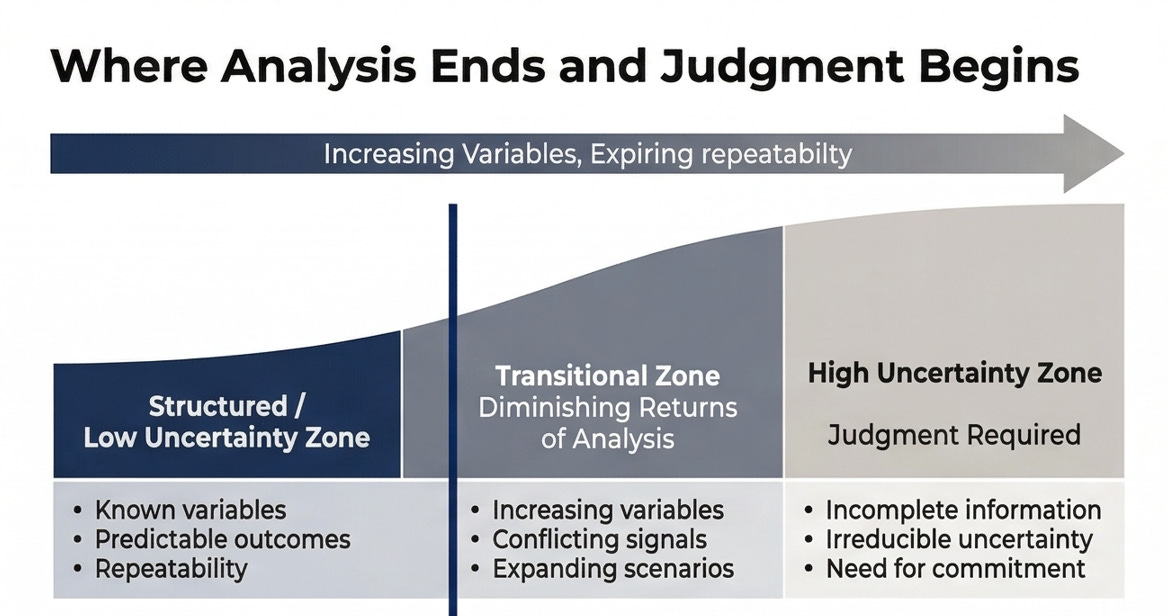
“Organizations rarely struggle because they lack analysis. They struggle because they continue to analyze past the point where analysis can help.”
Where Analysis Becomes Avoidance
The extension of analysis beyond its useful range is not only a technical issue. It is also behavioral. Analysis provides structure. It creates the sense that progress is being made. It distributes responsibility across models, data, and process. In conditions where outcomes are uncertain and accountability is high, these features become attractive.
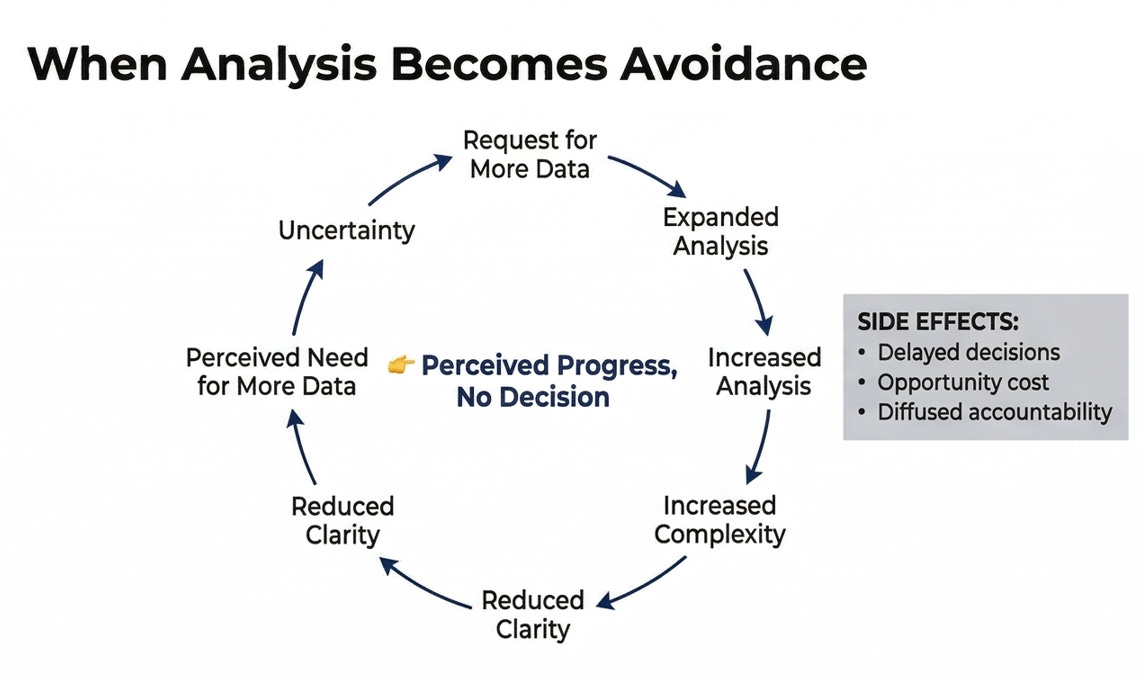
This creates a subtle but important shift. Analysis begins to function not only as a tool for understanding, but as a mechanism for deferring commitment. Additional data can always be gathered. Assumptions can always be refined. Scenarios can always be expanded. Each step appears reasonable. Collectively, they can create a form of motion that substitutes for decision.
“Analysis, when extended beyond its limits, becomes a socially acceptable form of avoidance.”
This is rarely experienced as avoidance by the individuals involved. It feels like diligence. It is often rewarded as rigor. Leaders who push for additional analysis are seen as thorough. Those who move to decision earlier may be perceived as premature. The organizational signal reinforces continuation. The decision itself becomes the point of greatest risk, not because it is poorly informed, but because it requires ownership in the absence of certainty.
Consider a capital allocation decision involving a significant investment in a new product line. Initial analysis produces a range of outcomes with wide variance. Market demand is uncertain. Cost structures are evolving. Competitive responses are unclear. Rather than moving toward a judgment, the organization commissions additional research, refines projections, and extends timelines. Each iteration produces more data, but not more convergence. Over time, the opportunity window begins to shift. Competitors move. Costs change. The eventual decision, when made, is evaluated against conditions that no longer match those under which it was originally framed. The organization did not lack analysis. It deferred judgment while the environment continued to evolve.
Judgment as a Distinct Capability
Judgment operates at the point where analysis can no longer carry the decision forward. It is not a residual activity that occurs after thinking is complete. It is the mechanism that enables action when thinking cannot fully resolve the problem. This distinction is often obscured because judgment lacks the visible artifacts of analysis. It does not produce a model or a dataset that can be reviewed independently. It produces a commitment to act under conditions where the outcome cannot be guaranteed.
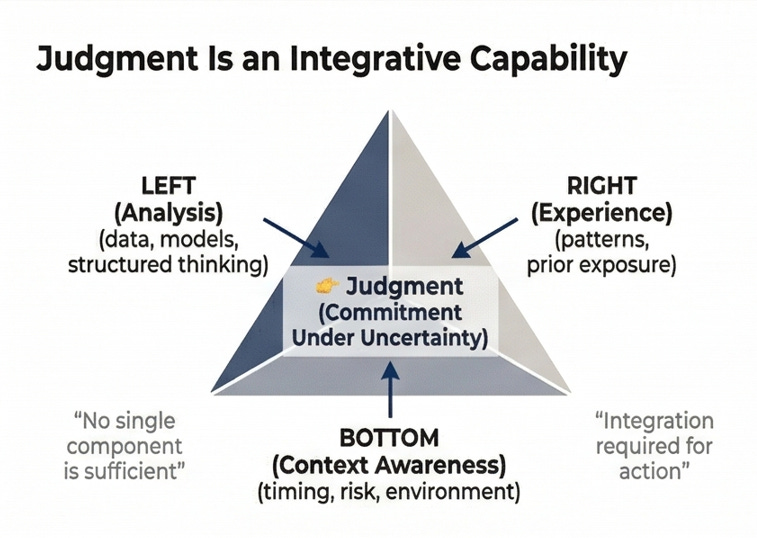
“Judgment is not what remains when analysis is finished. It is what determines action when analysis is insufficient.”
Strong judgment is not defined by confidence or speed alone. It is defined by calibration. It reflects an understanding of what is known, what is assumed, and what remains uncertain. It involves the ability to weigh incomplete and sometimes conflicting information without forcing premature resolution. It requires the capacity to act without full justification, while remaining open to updating the decision as new information emerges.
Weak judgment often presents differently. It may appear decisive, but it collapses uncertainty too quickly. It may appear analytical, but it continues to seek confirmation rather than recognize its limits. It may appear cautious, but it delays action under the assumption that clarity will emerge with time. In each case, the issue is not effort or intent. It is the misalignment between the nature of the decision and the approach being applied to it.
Experience, Pattern Recognition, and Constraint
Experience plays a central role in judgment, but its function is frequently misunderstood. It does not provide stored answers that can be applied directly to new situations. It provides patterns that allow individuals to recognize structural similarities across different contexts. These patterns can accelerate interpretation and support faster movement to action.
Under uncertainty, however, pattern recognition introduces both advantages and constraints. It allows experienced decision-makers to move more quickly, but it also shapes perception before sufficient information has been considered. The same mechanism that enables insight can reinforce misinterpretation when conditions differ in ways that are not immediately visible.
The difference between effective and ineffective use of experience lies in how patterns are held. When patterns are treated as provisional, they provide a starting point that can be refined. When they are treated as definitive, they constrain perception and reduce the ability to adapt.
Consider a product launch decision in a market that appears similar to one in which the organization has previously succeeded. Early indicators align with expectations. Customer segments appear familiar. Pricing models seem transferable. Based on this, the organization moves quickly to apply an existing strategy. Initial performance reinforces confidence. Over time, however, differences in customer behavior and competitive dynamics begin to emerge. The strategy, while initially effective, fails to adapt to these differences. The limitation was not a lack of experience. It was the early stabilization of a frame that was not sufficiently tested.
Speed, Timing, and the Cost of Delay
Under uncertainty, the timing of a decision becomes inseparable from its quality. Delaying action can improve understanding, but it can also increase exposure to changing conditions. Acting quickly can reduce uncertainty by forcing engagement with reality, but it can also increase the likelihood of error. The relationship between speed and accuracy is not fixed. It must be managed in context.
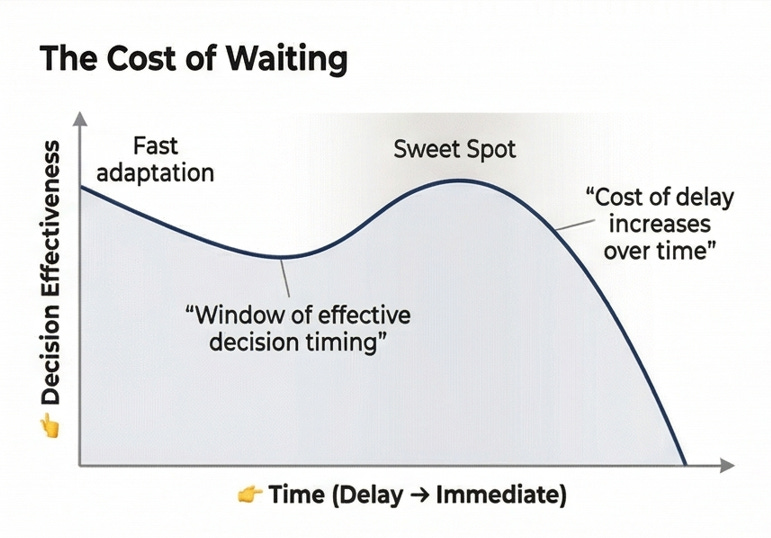
“The cost of delay is rarely neutral. It reshapes the decision while the decision is being deferred.”
In practice, this dynamic is often obscured by process. Decisions are moved through stages, reviewed by multiple stakeholders, and supported by additional analysis. Each step appears to increase rigor. It also extends the timeline. By the time a decision is made, the conditions under which it was originally framed may have shifted. The decision is then evaluated against outcomes that are partially the result of the delay itself.
This creates a reinforcing loop. When outcomes are uncertain or unfavorable, the response is often to increase analysis and process in future decisions. This is intended to improve quality. It can also increase latency, reducing the organization’s ability to respond to change. The system becomes more controlled and less adaptive at the same time.
Judgment in Organizational Systems
In organizations, judgment is not exercised in isolation. It is embedded within systems of authority, interaction, and accountability. Multiple perspectives are brought forward. Analysis is shared. Recommendations are debated. Decisions are shaped not only by information, but by incentives, norms, and power dynamics.
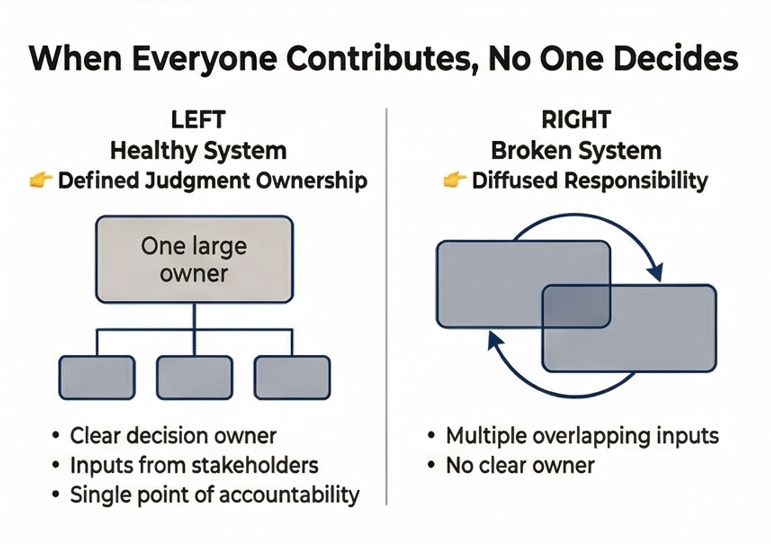
These factors influence how uncertainty is engaged. When accountability is unclear, judgment is often deferred. Individuals seek alignment as a substitute for ownership. When alignment is prioritized over accuracy, dissenting perspectives are minimized or reframed. When speed is emphasized without clarity of responsibility, decisions may be made quickly but without sufficient integration of available insight.
“Many organizations do not fail to decide. They fail to decide clearly who is deciding.”
This diffusion of judgment creates a condition in which decisions appear collective but are owned by no one. The result is not only slower decisions, but weaker ones. Without clear ownership, there is limited incentive to engage uncertainty directly. The system defaults to additional analysis or extended discussion, both of which delay commitment without resolving ambiguity.
Effective decision systems do not eliminate tension between speed, accuracy, alignment, and accountability. They make those tensions explicit. They clarify where judgment resides, how it is informed, and how it is evaluated after the fact. Without this clarity, organizations often mistake process for discipline and alignment for correctness.
Diagnostic Questions
To assess whether judgment is functioning effectively under uncertainty, consider:
Nature of Uncertainty - What elements of this decision cannot be resolved in advance? Are we treating uncertainty as something to eliminate or something to navigate?
Limits of Analysis - At what point is additional analysis no longer improving clarity? Are we expanding the problem space faster than we can resolve it?
Use of Experience - What patterns are shaping our interpretation? Where might those patterns be constraining our view?
Timing and Exposure - What is the cost of delaying this decision? How might conditions change while we continue to analyze?
Ownership of Judgment - Who is accountable for the final decision? Is judgment being exercised, or diffused across the system?
Closing
Decisions made under uncertainty cannot be reduced to calculation. They require the integration of analysis, experience, and judgment in conditions where none of these is sufficient on its own. The expectation that certainty can be achieved before action leads to extended analysis, delayed commitment, and an increasing distance between understanding and execution.
The more difficult recognition is that uncertainty is not a problem to be solved. It is a condition to be navigated. Organizations that fail to make this shift continue to invest in analysis long after it has stopped improving decision-making, while avoiding the moment when judgment must be exercised.
At that point, the system appears disciplined. It is structured, thorough, and methodical. It is also stalled.
Because the risk is not that decisions will be made with uncertainty present. That is unavoidable. The risk is that organizations will continue to behave as though uncertainty can be removed before acting, and in doing so, substitute analysis for judgment, process for ownership, and motion for progress.
And when that happens, decisions are not avoided. They are made by default, shaped by delay, drift, and changing conditions rather than by deliberate choice.